Dynamics in depth
When does a dynamical structure begin to look particle-like?
Here, “particle-like” is an operational resemblance—not an ontological claim. The question is whether a deterministic, memory-bearing structure can form, persist, escape, carry a spectrum, and respond causally to another structure.
Operational checklist
Five behaviors worth separating from the word “particle.”
None is sufficient on its own. Together they define the current experimental program and, more importantly, expose what remains missing.
A low-energy co-ignition window selects an antisymmetric phase-locked sector.
The selected sector holds for a finite, state-dependent interval rather than disappearing immediately.
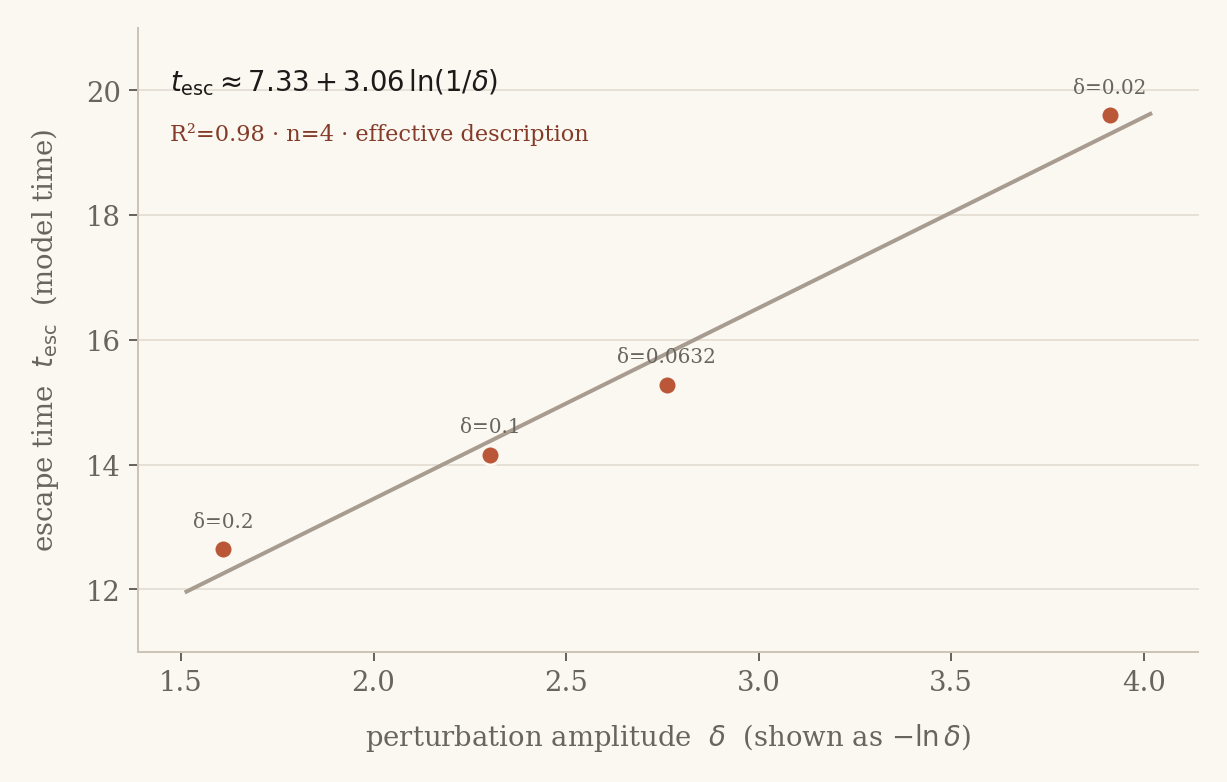
A seeded perturbation produces a reproducible departure time from the symmetric manifold.
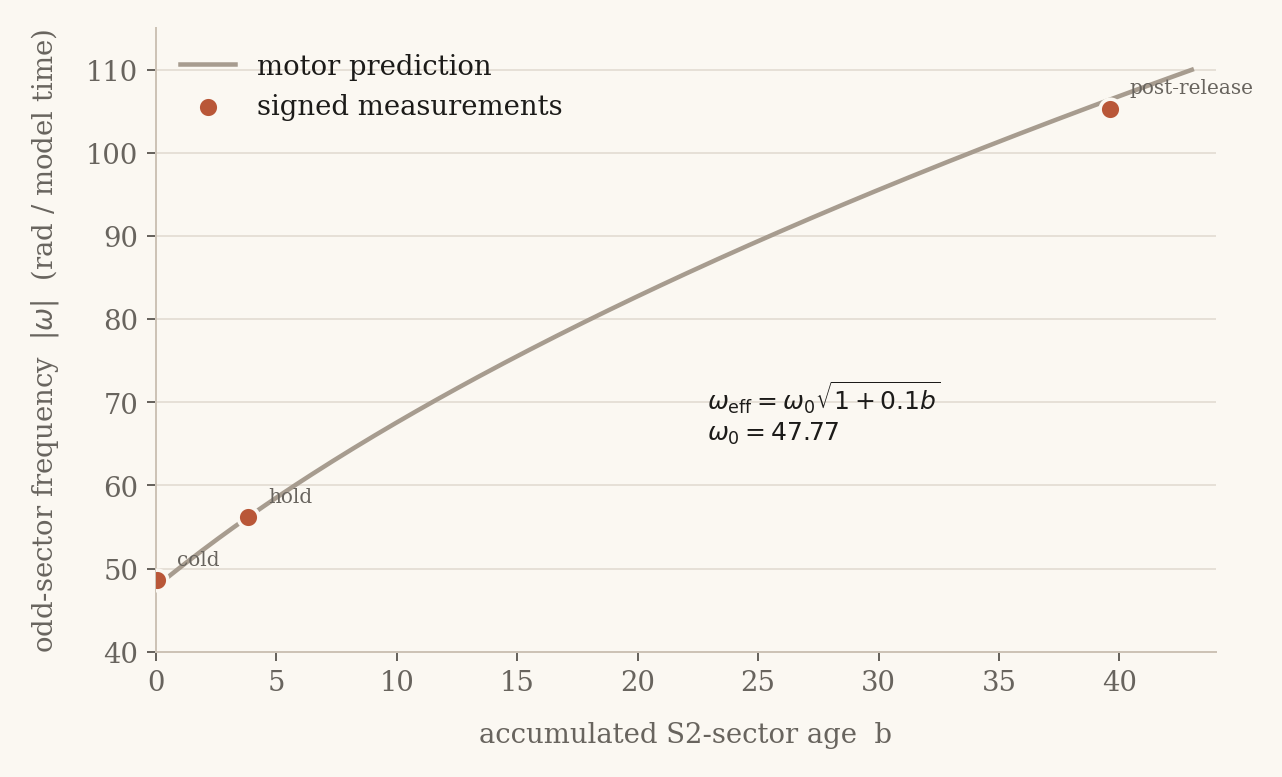
An internal odd-sector frequency tracks accumulated dynamical age and admits an exact linear-mode anchor.
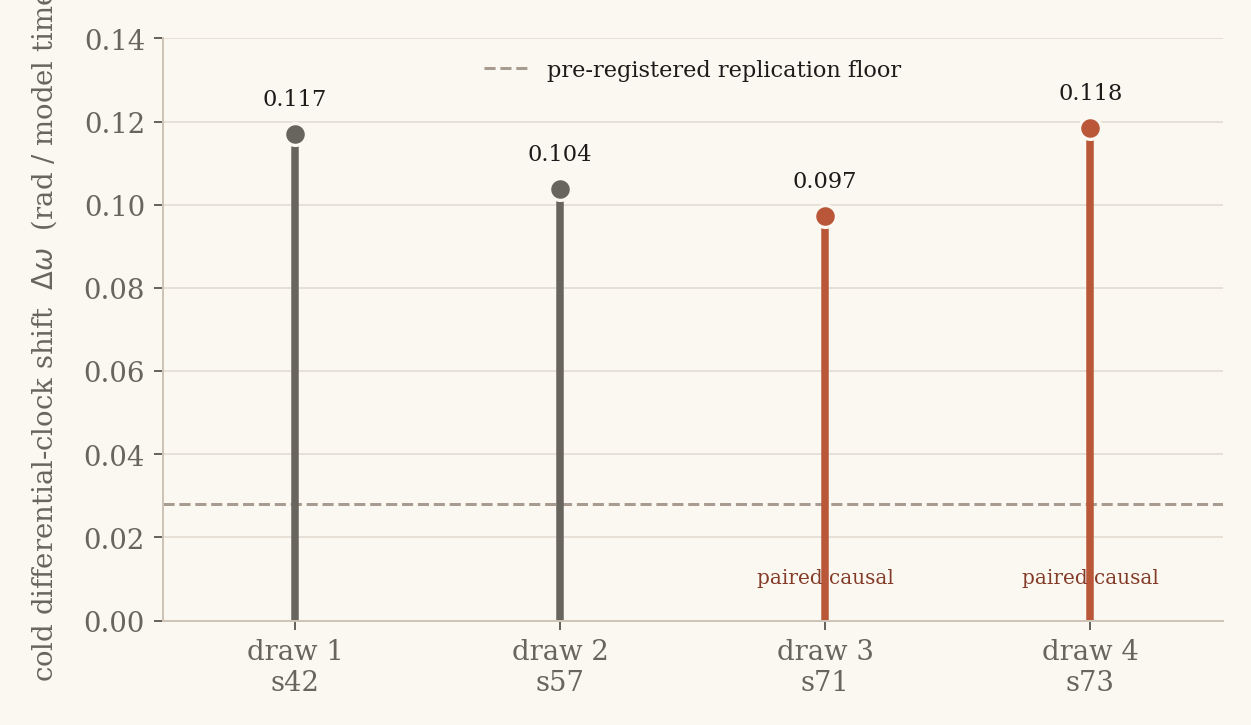
A single switched link produces a differential clock shift in bit-identical paired counterfactuals.
Formation and escape
A finite-lived sector with a measurable route out.
The first two figures concern selection and persistence of an antisymmetric phase-locked sector. They are suggestive of a bound-state picture, but they remain statements about this model family.
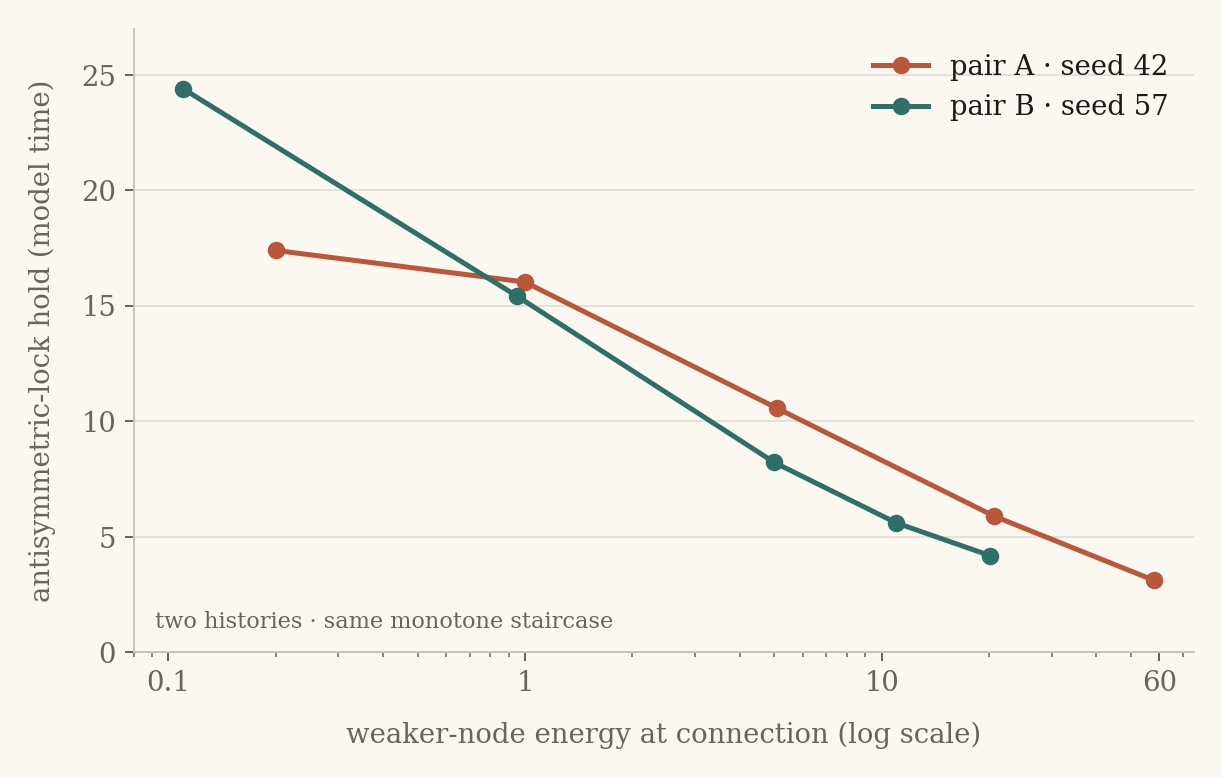
Study 06 · §72 / §74
The hold decays smoothly with weaker-node energy.
Study 06 · §73
Escape time is approximately logarithmic in seed size.
Study 06 · §74
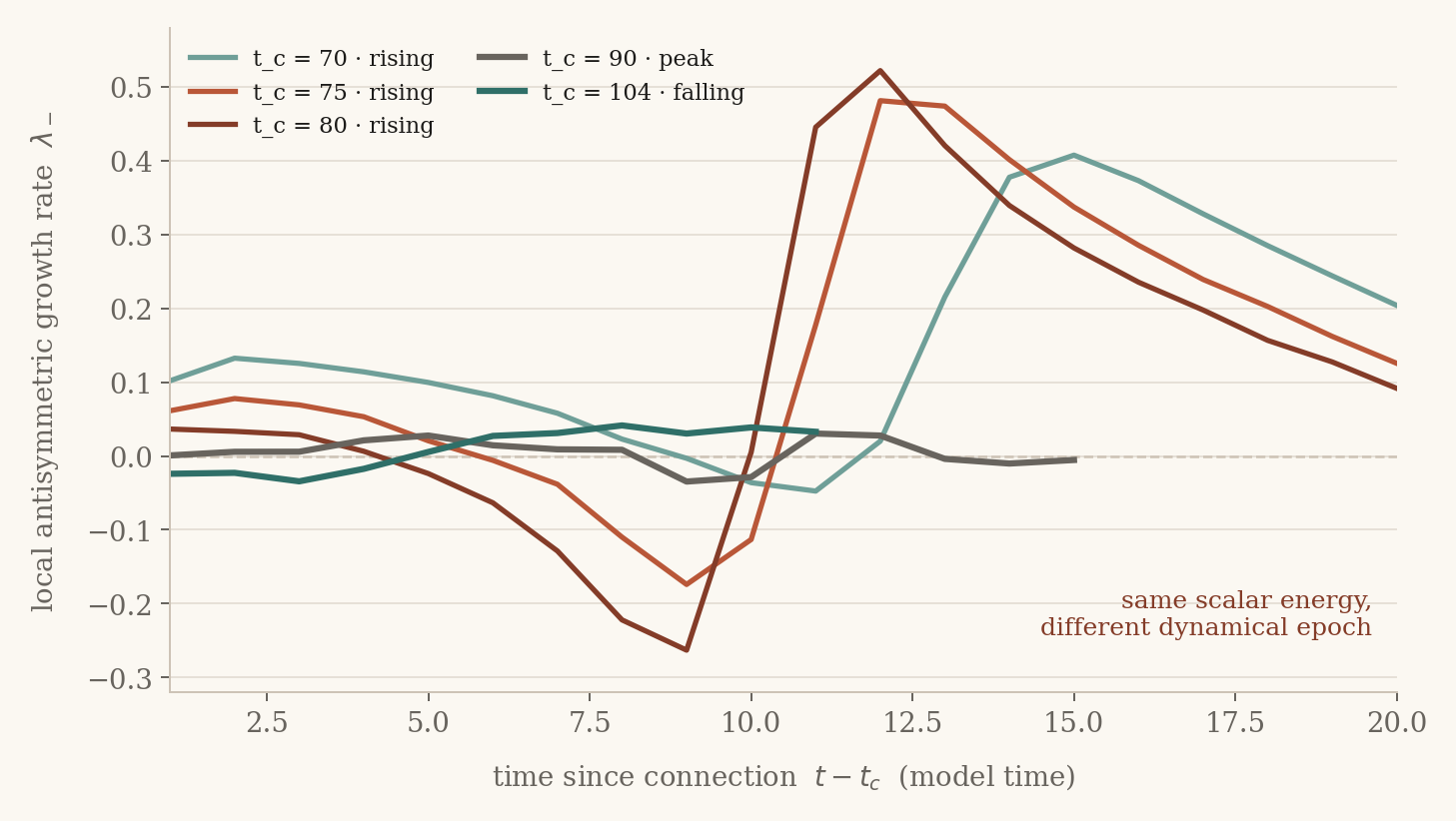
The instability pulse depends on epoch, not scalar energy.
Spectrum and interaction
An internal clock—and a link that changes it.
The strongest particle-like analogy currently comes from the combination of a state-dependent spectral readout and a paired causal interaction test.
Study 06 · §78 / §79
The odd-sector frequency reads accumulated age.
Study 06 · §79-c / d / e
The connection produces a differential clock shift.
Where the analogy stops
Interesting dynamics are not yet a particle theory.
- Formation of an odd-parity phase sector
- Finite hold, release, and seeded escape
- State-dependent spectral readout
- Exact linear-mode anchor
- Interaction-induced clock splitting
- A transferable interaction or scattering law
- Dispersion and scaling beyond the tested networks
- A conserved identity across formation and interaction
- Independent experimental correspondence
- Any connection to relativistic particle ontology
Notation used on this page
- S2
- Fast internal layer used to define the odd/even pair sectors.
- b
- Accumulated dressing or age variable in the current model; not physical time itself.
- λ₋
- Local odd-sector growth rate, λ₋ = ½ d(ln E₋)/dt, estimated on in-life windows.
- Δω
- Differential frequency, ω̂₋ − ω̂₊; it cancels a common intra-node eigenmode.
- draw
- One independently seeded deterministic realization—the statistical unit used here.
Source record
Read the figures with their full experimental history.
The versioned artifact includes all seven original charts, retractions, method notes, and the qualitative distance map to known physics. Daily logs preserve preregistration, panel decisions, software receipts, and post-run verdicts.
Open the exact source artifact Browse the Study 06 repository